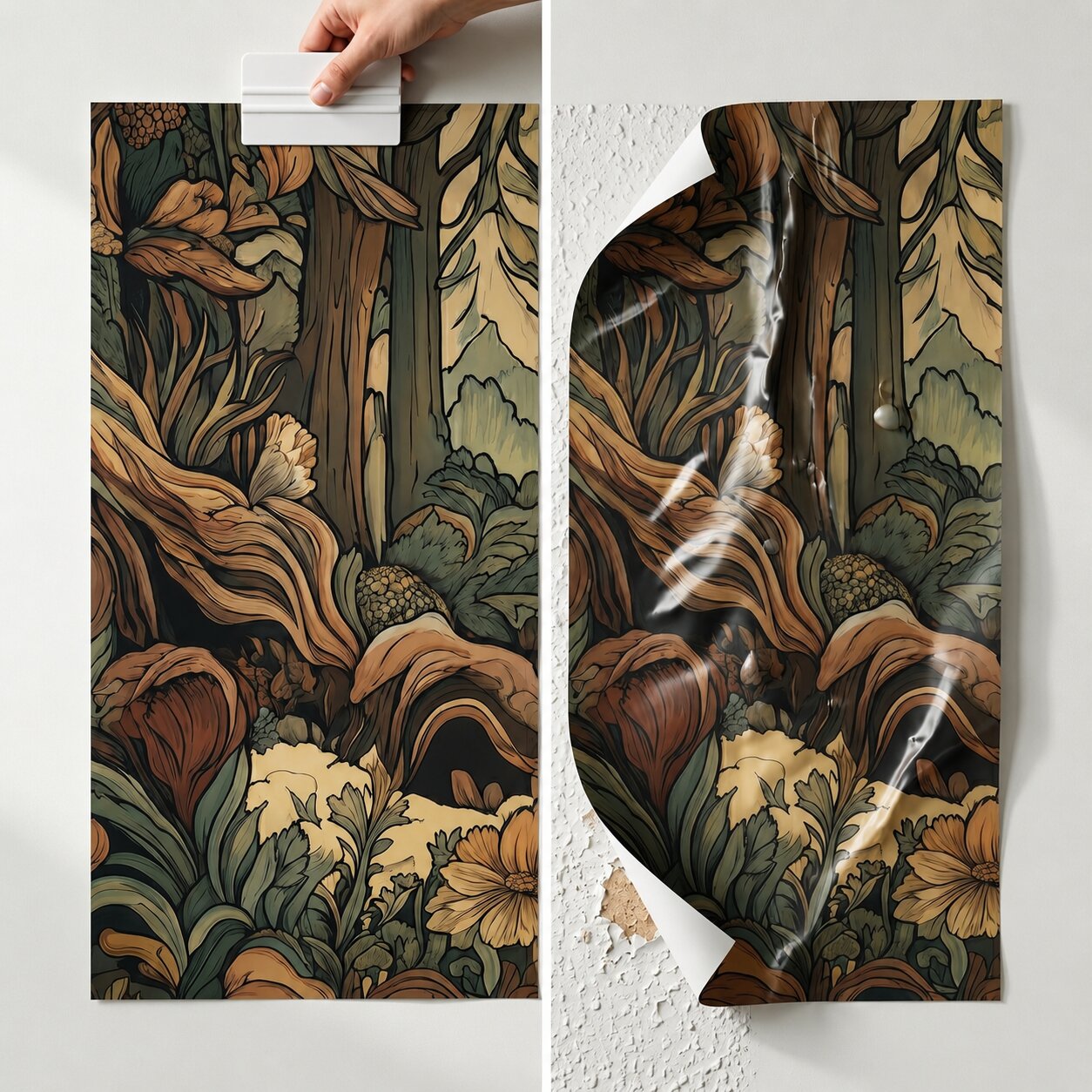
Peel and stick murals on textured walls succeed or fail based on three variables: the specific texture type, the mural's material thickness, and how thoroughly the surface is prepped before installation. Outcome ranges from fully compatible on smooth and lightly textured walls to reliably incompatible on popcorn and deep knockdown — which means knowing your wall type before you order is the single most important step in the process.
Yes — but only for certain texture types, and with the right material.
Here's the honest breakdown by texture:
| Texture Type | Verdict | What You Need |
|---|---|---|
| Smooth / Level 5 | Works | Standard prep |
| Light orange peel | Works with prep | Thicker mural material + test sample |
| Heavy orange peel | Risky | Consider smoothing wall first |
| Knockdown / skip trowel | Not recommended | Skim coat or wall liner required |
| Popcorn / heavy acoustic | Incompatible | Surface prep mandatory before anything |
Find your texture in the guide below. Each type gets a specific, honest verdict — not a vague "it depends."

Run your palm slowly across the wall in natural light. The way the surface feels and how it casts shadows tells you more than any photo.
A smooth wall — known in the trades as a Level 5 finish — has been taped, mudded, sanded, and skim coated to eliminate surface variation. The adhesive makes full contact, and most murals perform exactly as the manufacturer intends. This is the ideal starting point for any living space or bedroom installation.
Verdict: Fully compatible. Standard prep applies.
Good collections for smooth walls:
Orange peel is the most common residential drywall finish in the US, named for its shallow, evenly distributed dimples. In its lighter form, the bumps are small and rounded. Most quality murals — particularly fabric-backed or non-woven materials — can bridge these small gaps and hold well, though some faint surface variation may remain visible depending on lighting.
Verdict: Generally compatible with the right mural and proper prep. Test a sample first.
Quick tip: Busy or dark-toned designs naturally mask any residual texture. A dense botanical or rustic wood pattern will hide lightly textured walls far better than a plain, light-colored print.
Good collections for lightly textured walls:
Heavy orange peel uses larger droplets of compound that dry into more prominent peaks with deeper valleys between them. On this surface, thin vinyl murals typically show the wall's texture through the face material — a problem called telegraphing — and are prone to edge lifting over time.
Verdict: Higher risk. Thicker material helps; smoothing the wall first is the more reliable path.
Knockdown starts as a spray application that's partially flattened with a drywall knife before curing, leaving broad flat plateaus separated by irregular canyons. Skip trowel is similar but applied manually, producing an even more distressed, stucco-like look — common in Southwest US homes.
Both textures are challenging for peel and stick application. The flat tops look promising, but the deep canyons trap air and significantly reduce the usable adhesive contact area.
Verdict: Not recommended without wall prep. Skim coat or wall liner required for reliable adhesion.
Popcorn texture — found on ceilings and some walls from the 1960s through 1980s — is a heavily dimensional, fragile surface made from aggregate material. The texture itself can crumble and separate from the drywall under the weight of a mural, regardless of adhesive strength.
Verdict: Incompatible. Do not attempt direct application.
Safety note: Pre-1978 popcorn texture may contain asbestos. Consult the EPA's guidance on asbestos-containing materials before disturbing any older acoustic texture.

Peel and stick murals use pressure-sensitive adhesives — polymers that are already solid when you peel the backing. Unlike traditional wallpaper paste, which flows into surface gaps as a liquid, a pressure-sensitive adhesive can only bond where it physically touches the wall.
What happens on a textured wall:
The more pronounced the texture, the less adhesive contact, and the faster this process unfolds. On smooth walls, it doesn't happen at all. On heavy orange peel or knockdown, it can begin within weeks.
Mural thickness — measured in mils (one-thousandth of an inch) — is the single most important material specification for applying wallpaper on textured walls.
Standard budget murals in this range are engineered for conformability. On smooth walls, that's an asset. On texture, it's a liability:
Premium mural materials in this range — woven fabrics, non-woven composites, canvas-like blends — behave like a structural bridge across texture peaks instead of conforming into the valleys. Key advantages:
Bottom line: If your wall has any texture, look for mil thickness in the product specs before ordering. If it isn't published, ask. Materials without published specs are typically in the thin range.
Skipping prep is the most common reason murals fail — even on compatible surfaces. Follow these steps regardless of texture level.
Step 1 — Clean the wall Wipe with a damp cloth to remove dust and grease. Textured surfaces collect far more airborne debris than smooth ones because the ridges act as shelves. Let dry fully for at least 24 hours. For greasy areas (kitchens, near cooking surfaces), wipe with isopropyl alcohol — soap leaves a film that repels adhesive.
Step 2 — Wait for paint to cure Freshly painted walls off-gas as they cure. Installing over uncured paint traps those vapors under the vinyl, causing bubbling. Wait a minimum of 4 weeks after painting before applying any mural.
Step 3 — Repair surface defects Fill cracks, nail holes, and unintentional gouges with spackling compound. Sand flush. Any irregularity beyond the wall's intended texture will telegraph through the mural face.
Step 4 — Press firmly during installation Use a firm plastic squeegee in slow, overlapping strokes from the center of each panel outward. This step alone significantly improves adhesion on lightly textured walls by maximizing contact between the adhesive and the surface peaks.
Tools you'll need:
For moderate to heavy textures, yes — and it's often the right move. Two options:
Spread a thin layer of joint compound across the wall to fill the valleys, sand smooth, and prime. The result is a Level 5 finish: full adhesive contact guaranteed. Labor-intensive, generates fine drywall dust, takes several days — but it's the most reliable foundation for any large-format mural.
Best for: Knockdown, skip trowel, or heavy orange peel walls where you want to achieve a permanent, durable result.
A heavy non-woven blank paper hung with traditional paste-the-wall adhesive before the decorative mural goes up. The liquid paste flows into surface gaps and cures into a mechanical bond with the wall. Cost: roughly $15–$40 per roll depending on coverage — substantially cheaper than professional skim coating.
Limits: Bridges light-to-moderate texture effectively. Won't tame deep knockdown or popcorn on its own.
Best for: Heavy orange peel, light knockdown, or renters who need a reversible solution.
Renter tip: Wall liner applied carefully can typically be wet-released at move-out without damaging paint — a better approach than fighting a textured wall directly with peel and stick.
Edge lifting or corner curling (early, small) Apply heat with a hair dryer to soften the vinyl, then press firmly back down with a squeegee. Heat temporarily lowers the adhesive's viscosity enough to improve contact. Catch it early — once dust enters the exposed adhesive, re-adhesion is unlikely.
Bubbles across the center of a panel Likely cause: texture too deep for the material, inadequate squeegee pressure, or paint that wasn't fully cured. Small bubbles can sometimes be worked toward the nearest edge while the adhesive is still fresh. Widespread bubbling means the wall needs prep before a reinstall.
Full panels dropping The texture is beyond the material's range. Remove cleanly, smooth the wall, and start over. Attempting to re-stick fallen panels over unprepped texture produces the same result.
The counterintuitive reality: on a textured wall, the mural may actually be easier to remove — because the bond was weaker to begin with. The risk shifts from wall damage to premature detachment during the installation's lifespan.
Lower-risk removal scenarios:
Higher-risk removal scenarios:
If residue remains in texture valleys, commercial adhesive removers or gel-based strippers dissolve the polymer bonds without requiring scraping that would damage the texture.
Real-world adhesion on textured drywall has been tested empirically. A five-month independent evaluation by Wildfire Interiors applied twelve peel and stick products to un-skimmed orange peel textured walls in a humidity- and temperature-variable environment, tracking results over 152 days (source: Wildfire Interiors).
Results summary:
| Result | Products | Common Factor |
|---|---|---|
| Full 152-day adhesion | 6 of 12 | Substrate mass 6+ mils; rigid backing |
| Partial lift or failure | 6 of 12 | Thin calendered vinyl, 3–5 mil range |
Failure timeline from the evaluation:
In each case, the common factor was low substrate thickness and adhesive systems optimized for smooth drywall. The products that passed all used heavier, more rigid substrate compositions.
The Wildfire Interiors test used orange peel — which are among the more workable textured surfaces for peel-and-stick wallpaper. Even so, peel-and-stick products are generally designed for smooth, clean walls, and rougher finishes can reduce adhesion.
Murals also differ from standard wallpaper rolls in one important way: they cover significantly more surface area per piece. Any adhesion weakness gets multiplied across larger panels — which makes material selection more consequential for murals than for tiled wallpaper installations.
Orange peel is the texture category with the widest range of viable peel and stick options. Its shallow, uniform dimples allow thick substrates to span gaps while maintaining consistent adhesive pressure across multiple contact points.
Light orange peel reduces adhesive contact to roughly 70–80% of total wall surface area, per technical analysis from American Decals (source: American Decals). That's a meaningful reduction — but workable with a mural in the 6+ mil range and a high-tack adhesive formulation.
Heavy orange peel drops that contact percentage further, compounding the challenge. Two factors help mitigate it:
Manufacturer guidance consistently recommends pressing a sample panel firmly onto the most textured section of the wall and leaving it for 48–72 hours before ordering the full mural (source: Tempaper). If any edge lifts during that window, the wall needs prep or the material needs to be upgraded.
Collections that work well on lightly textured orange peel walls:
Knockdown texture's adhesion failure mechanism differs from orange peel's in one critical way: the problem isn't peak height — it's canyon volume.
The flat plateaus of knockdown texture would bond well on their own. The issue is what's between them. Unlike orange peel dimples — which contain small, bounded air volumes — the interconnected canyons of knockdown texture trap enough air to generate meaningful hydrostatic pressure as room temperature fluctuates daily.
Peel-and-stick wallpaper is generally designed for smooth walls, and textured walls can interfere with adhesion. Tempaper says its peel-and-stick wallpaper is not recommended for textured walls, though it may stick to slightly textured surfaces in some cases.
Most premium peel and stick manufacturers explicitly exclude knockdown and skip trowel from product warranties.
Skim coating: Spread joint compound across the entire surface, fill the canyons, sand smooth, prime. Permanent, labor-intensive, produces fine silica dust. Best for a house or room you're committed to for the long term.
Paste-the-wall liner: A heavy non-woven liner applied with liquid adhesive bridges the voids by filling them as a fluid rather than bridging them as a film. Products designed for this are purpose-built for this application.
The key distinction: traditional paste adhesives are liquid during application and cure into a continuous mechanical bond with the wall. Peel and stick adhesives are already solid. That's the fundamental reason liner works where direct peel and stick application doesn't.
Mil thickness governs three properties that determine performance on uneven surfaces: tensile strength, modulus of elasticity (resistance to deformation), and gap-bridging capability.
At 3–4 mils, calendered vinyl is highly pliable. Under squeegee pressure, it deforms into the texture valleys rather than spanning them. The resulting internal stress concentrates at the edges and seams — the areas with the least adhesive contact — and works against the bond from day one.
At 8–10 mils, the material is thick enough to bridge light surface texture, but it is still dependent on substrate conditions and wall prep. Orange peel and knockdown textures often need smoothing before wallpapering, which is why lightly textured walls are less reliable than smooth drywall.
Commercial textured vinyl products in the 10–16 mil range go further, pairing their substrate mass with fabric-reinforced, high-tack adhesive formulations designed for porous and irregular substrates — including brick, stucco, and existing heavy wall textures.

For heavily textured surfaces where skim coating feels like too much work, a wall liner is the most practical intermediate step. At $15–$40 per roll, it's significantly cheaper than professional skim coating and produces a meaningfully smoother surface.
Wall liner is a heavy-duty non-woven blank paper hung using traditional paste-the-wall adhesive. The liquid paste flows into the texture's valleys during application and cures into a continuous bond with the wall surface. Once dry, the liner presents a flat, stable substrate that the decorative mural can adhere to with full contact.
Yes, with the right surface and material. Light orange peel is generally compatible with thicker mural materials when the wall is clean and properly prepped. Moderate orange peel can work with careful material selection, though some residual texture may be faintly visible. Knockdown, skip trowel, and popcorn textures require smoothing the wall first — either by skim coating or applying a paste-the-wall liner — before any peel and stick mural will hold reliably. When in doubt, test a sample panel on the most textured section of your wall for 48–72 hours before ordering the full mural.
A practical field test: press your palm flat against the wall and drag it slowly. Small, closely spaced bumps that feel mildly rough — light orange peel territory — are workable with the right material. Distinctly bumpy surfaces with visible ridges or shadows, or surfaces where your fingertips catch on raised edges, are past the threshold where most peel and stick products hold reliably. Surfaces with deep, interconnected canyons (knockdown, skip trowel) or friable raised texture (popcorn) should be smoothed first. When uncertain, the 48-hour sample test will tell you more than any visual assessment.
Clean the wall with a damp cloth, let dry fully for 24 hours, and wait at least 4 weeks after painting before applying anything. Fill cracks and nail holes with spackling compound and sand flush. For heavier textures, apply a paste-the-wall wall liner and let it cure fully before installing the mural. During installation, use a firm squeegee in slow, overlapping strokes from panel center outward. That squeegee pressure step alone makes a measurable difference in adhesion quality on any lightly textured surface.
Generally yes on light orange peel, provided the mural material is 6 mils or thicker. Thicker substrates span the shallow dimples rather than conforming into them, maintaining visual integrity and adhesive contact at the peaks. Thin 3–4 mil vinyl telegraphs the texture and tends to fail at edges over time. Design selection also matters: busier patterns and darker palettes mask any residual surface variation that lighter prints would reveal under directional lighting.
Direct application isn't recommended by most peel and stick manufacturers, and many explicitly void warranties for these surfaces. The interconnected voids in knockdown texture trap enough air to generate progressive adhesion failure as temperature fluctuates. The reliable path is to fill those voids first — skim coating with joint compound for a permanent result, or a paste-the-wall liner as a faster, less invasive option. Once the surface is smooth, the mural installs as it would on any flat wall.
Material requirements depend on texture type, so there's no single answer. For light orange peel, a non-woven or fabric-backed substrate in the 6–9 mil range performs well. For heavier textures, the wall typically needs to be smoothed first before any peel and stick product is reliable long-term. Look for published mil thickness in the product specs — it's the most useful single data point for evaluating a product's suitability for textured surfaces. In multi-month real-world testing on orange peel, heavier non-woven and woven linen formats consistently held where thin calendered vinyls failed (source: Wildfire Interiors).
Not reliably. On rough or heavily textured surfaces, the adhesive contacts only the peaks while spanning large voids — contact area that's insufficient to counter the combined forces of gravity, daily temperature cycling, and the substrate's own mechanical memory. Rough and heavily textured surfaces generally require smoothing first: skim coating for a permanent solution, or a paste-the-wall liner as a less intensive alternative.
It depends on what's underneath. On a properly primed, fully cured wall with eggshell or satin finish, most quality murals release cleanly. The higher-risk scenario is unprimed flat or matte paint in poor condition — the adhesive can bond more strongly to the paint than the paint bonds to the drywall, lifting paint or surface paper on removal. A dedicated wallcovering primer applied before installation reduces this risk significantly. During removal, a heat gun keeps the adhesive pliable and bonded to the vinyl backing rather than transferring to the wall.
For walls that haven't been smoothed, paste-the-wall, pre-pasted non-woven, and Type II commercial vinyl formats with fabric backing are the most reliable options. These use liquid adhesive during installation that flows into surface irregularities and cures into a mechanical bond — an advantage that solid pressure-sensitive adhesive cannot replicate on uneven surfaces. For light orange peel specifically, a thick peel and stick mural can perform adequately; for anything deeper, traditional installation methods offer a more reliable outcome.
Peel and stick murals are not suitable for popcorn or heavy acoustic texture. The aggregate material — which may include vermiculite or other friable components — doesn't provide stable adhesion points, and the texture's extreme surface variation far exceeds what any continuous adhesive film can span. Pre-1978 popcorn texture may also contain asbestos; the EPA recommends against disturbing suspected asbestos-containing materials without professional assessment. Popcorn removal or encapsulation must be completed before any mural installation is attempted.
Once you know your texture type and prep plan, the design is the fun part.
By room:
By style:
Have a photo or design in mind? Upload it and get a custom-printed mural made to your exact wall dimensions: Create Your Own Custom Mural
Questions about your specific wall? Contact the team at (888) 958-1991 or visit the FAQ page before ordering.
Charles Platon is the owner of Peel and Stick Wall Murals, a California-based leader in large-format wall decor printing. With a career rooted in photographic printing since the 1980s, Charles blends old-school craftsmanship with modern wall design innovation. After a decade at Noritsu, he returned to his family's printing business — founded in 1952 — and grew it into a trusted partner for brands like Panda Express, Guess, and Crate and Barrel.
His deep technical expertise, creative vision, and customer-first approach drive every mural Peel and Stick Wall Murals produces. When he's not overseeing production or collaborating on custom wall installations, Charles enjoys blues music and spending time with his daughter in New York.
This guide was created using a combination of expert knowledge, industry research, and content structuring tools. While AI-assisted tools (e.g., outline suggestions, formatting support) were used to improve organization and clarity, all research, writing, and final editing were performed by a human author with subject-matter expertise in large-format printing and wall decor.
All factual claims are supported by reputable sources, and the content was manually reviewed to ensure accuracy, readability, and helpfulness for real users — not just search engines.

Comments will be approved before showing up.

 MADE IN THE USA

