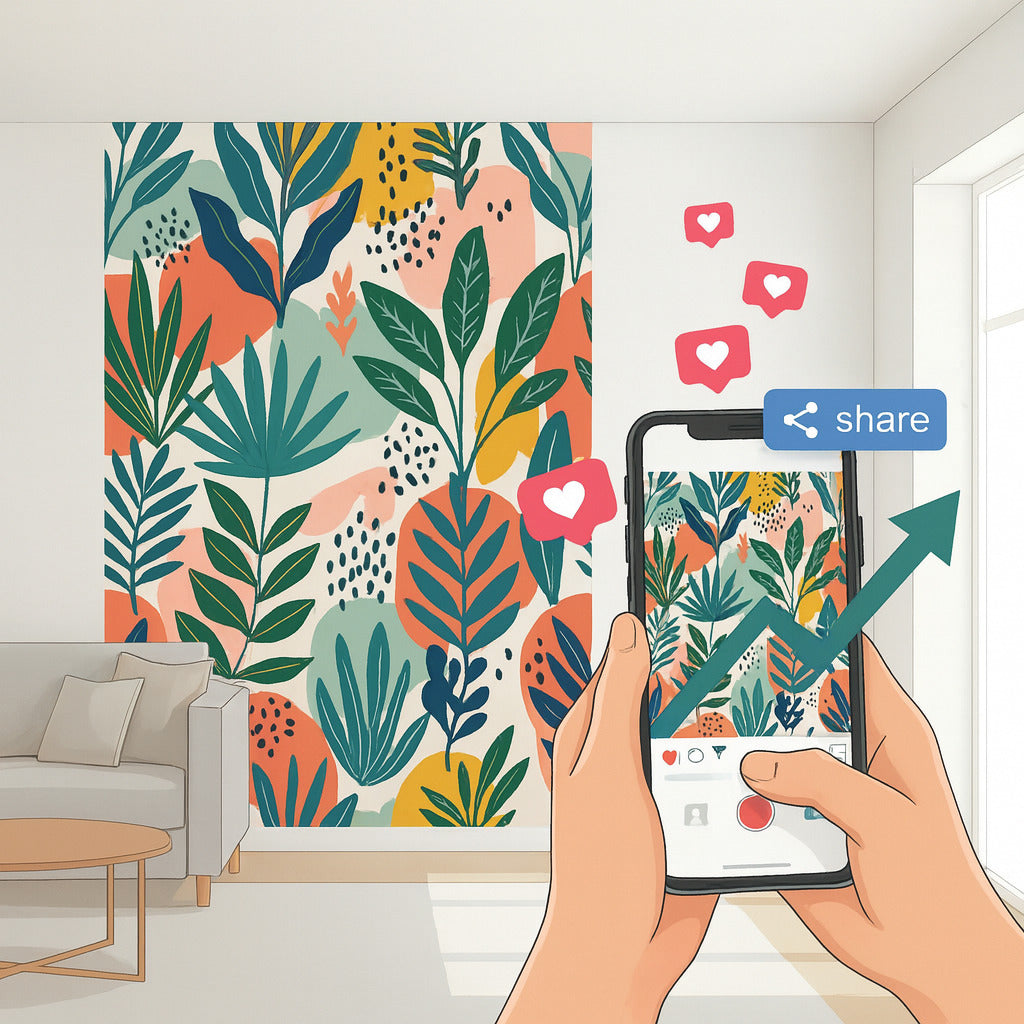
Peel and stick wall murals remain highly popular in 2025, with the global market valued at $2.5 billion and projected to reach $4.8 billion by 2032 (CAGR 8.6%). Consumer adoption reached 57% among renters and homeowners, while Google searches for "mural wallpaper" increased 5,000% since early 2025. Interior designers now consider large-scale murals essential for accent walls, moving beyond simple paint to create depth and personality in modern interiors.
Peel and stick wall murals are self-adhesive wallpaper featuring removable wall murals on backing material that adheres to walls without paste or professional installation. Unlike traditional wallpaper, these use pressure-sensitive adhesive technology creating temporary bonds with painted surfaces. The material includes options like self adhesive wallpaper in fabric, vinyl, or paper substrates with print quality matching traditional wallpapers.
Peel and stick wallpaper requires no paste or water, installs in minutes, and removes without damage. Traditional wallpaper creates permanent bonds requiring professional removal. Modern removable wallpaper matches traditional quality through advanced printing while offering easy application without long-term commitment.
Options include photo murals, abstract art, geometric patterns, botanical themes, and custom designs. Materials range from textured surfaces mimicking grasscloth to smooth vinyl for bathrooms. Specialty features include metallic finishes and interactive elements.
Manufacturers use diverse substrates for wall graphics and coverings, including woven polyester fabric,PVC-free vinyl, fiber-based solutions, paper with protective coatings, and sustainable bamboo fibers. The adhesive layer usually consists of anacrylic polymer formulation that often incorporates microsphere technology; this enables repositionability by providing ongoing tackiness, allowing adjustments during installation without surface residue.
Premium products utilize water-based, low-VOC adhesives meeting GREENGUARD Gold certification standards for indoor air quality safety.
Market growth stems from rental housing trends (35% of Americans need non-permanent solutions), social media driving wall transformation content, and pandemic-era home personalization. Patent filings for adhesive technology increased 40% annually. Search data shows "peel and stick wallpaper" queries grew 156% (2023-2025), Pinterest saves increased 312%, and TikTok videos reached 2.3 billion views. Interior designers (78% surveyed) now recommend stick wall murals for client projects, noting quality rivals traditional wallpapers.
Installation requires no special tools—simply peel and apply. Damage-free removal preserves security deposits for renters. DIY projects save $500-1,500 in contractor fees per room. Unlike traditional wallpaper, mistakes correct through repositioning. Customization includes personal photos and AI-generated designs. Wall murals instantly transform spaces, with forest scenes proven to reduce stress by 37%. The perfect solution for temporary updates without sticky residue or long-term commitment.

Installation simplicity stems from elimination of paste mixing, wall priming, and booking time requirements that characterize traditional methods. A single person can install an 8x10 foot mural in under 90 minutes, compared to 4-6 hours for paste-based equivalents requiring two people. The dry application process prevents bubbling from excess moisture, while grid-lined backing papers ensure precise alignment without complex measuring calculations.
Quality products incorporate controlled-release adhesives that bond to paint films rather than penetrating to drywall substrate, preventing paper tears during removal. The adhesive layer acts as a protective barrier against minor impacts and stains, actually preserving underlying paint better than exposed surfaces. When removed properly using recommended 45-degree angle technique, these murals leave walls in original condition without residue or discoloration.

Customization capabilities have expanded dramatically through digital printing advances and AI-powered design tools enabling infinite personalization options. Companies offer upload services transforming personal photographs into wall-sized murals with professional color correction and resolution optimization. Modular systems allow mixing patterns and colors to create unique compositions, while some manufacturers provide augmented reality previews showing exact appearance in specific rooms.
Visual impact occurs immediately upon installation, converting blank walls into artistic focal points that establish mood and define spatial character. A single forest mural can create biophilic connections proven to reduce stress by 37% in university studies, while geometric patterns add contemporary sophistication previously requiring expensive architectural interventions. The scale of transformation—covering entire walls rather than hanging multiple small artworks—delivers dramatic results that traditionally required substantial renovation investment.
Primary adoption occurs among urban renters aged 25-40 who change residences every 2-3 years and cannot modify permanent structures. Homeowners comprise 42% of the market, using removable murals for children's rooms that require frequent updates and guest spaces needing temporary transformations. Commercial applications are expanding rapidly, with co-working spaces, retail pop-ups, and hospitality venues leveraging murals for brand expression without long-term commitments.
Rental agreements typically prohibit permanent modifications, making removable options the only viable path for personalization without risking security deposits averaging $1,500-3,000. Students face additional challenges with dormitory regulations and annual moves, requiring decor solutions that pack efficiently and reinstall reliably. The average renter moves 6 times before purchasing property, making permanent wallpaper investments economically irrational.
Homeowners employ removable murals for staging properties before sale, creating appealing aesthetics that photograph well without permanent alterations affecting buyer preferences. Parents utilize them in nurseries and children's rooms where themes change with developmental stages—from nursery rhymes to superheroes to teenage interests. The ability to update powder rooms, accent walls, and seasonal decorations without contractor involvement appeals to DIY-oriented homeowners seeking frequent refreshment.
Commercial spaces benefit from rapid installation minimizing business disruption, with complete transformations accomplished overnight rather than multi-day traditional installations. Retail environments update displays seasonally using themed murals that would be cost-prohibitive with permanent treatments, while restaurants create Instagram-worthy backdrops driving social media marketing. The $3-7 per square foot cost represents 60% savings versus traditional commercial wallcovering installation.
Content creators leverage murals as dynamic backdrops for video production, changing aesthetics between series to maintain visual interest without studio relocation. Interior design influencers demonstrate transformation techniques using time-lapse installation videos that generate average view counts of 450,000 per post. The visual impact creates shareable before-and-after content that drives engagement rates 5x higher than standard decor posts.
The global market reached $2.5 billion (2025), projected to hit $4.8 billion by 2033. North America represents $1.1 billion; Asia-Pacific grows fastest at 10.2% CAGR. The wall art market totals $68.9 billion. Growth drivers: urbanization, e-commerce expansion (40% cost reduction), and environmental consciousness (31% seek sustainable options). Peel and stick costs $3-7/sq ft versus professional painting ($2-4) or traditional wallpaper ($5-12), but saves $500-1,500 in installation labor.
Peel and stick murals average $3-7 per square foot including materials, compared to professional painting at $2-4 per square foot or traditional wallpaper installation at $5-12 per square foot. However, total project costs favor removable options when factoring installation labor—DIY mural installation saves $500-1,500 per room in contractor fees. The ability to reuse murals across multiple moves provides additional value, with 34% of consumers successfully reinstalling products in new locations.

Natural textures lead (28% of sales)—forests, mountains, tropical scenes. Abstract art and geometric patterns appeal to minimalist style. Retro designs, maximalist florals, and vintage motifs are trending. Dark, moody aesthetics create dramatic spaces.
Ceiling wall murals ("fifth wall") increased 340%. Biophilic designs connect urban dwellers with nature. Popular colors: earth tones (terracotta, sage green), pastels for nurseries. Custom photo murals and AI-generated unique designs comprise 15% of market.
Nature photography murals lead sales with tropical jungle scenes, misty forests, and ocean vistas creating immersive environments addressing urban dwellers' nature deficit. Architectural illusions including bookshelf patterns, brick textures, and window views provide depth to small spaces without structural modifications. Vintage botanical illustrations and art reproduction murals offer sophisticated alternatives to expensive original artwork.
Warm earth tones dominate with terracotta, sage green, and ochre appearing in 45% of bestselling designs, reflecting broader interior design trends toward organic palettes. Dark, moody aesthetics featuring deep blues, charcoals, and forest greens create dramatic spaces particularly popular in bedrooms and home offices. Soft pastels maintain steady demand in nurseries and children's spaces, while metallic accents add luxury touches to contemporary designs.
1970s-inspired patterns featuring bold geometrics and sunset gradients experience 180% sales growth as millennials embrace nostalgic aesthetics. Chinoiserie designs and toile patterns appeal to grandmillennial trends combining traditional motifs with modern application methods. William Morris reproductions and Art Deco geometrics provide historical reference while maintaining contemporary relevance through updated color palettes.
Ceiling applications increased 340% as consumers discover "fifth wall" potential for creating immersive environments, particularly sky and constellation themes in bedrooms. Powder rooms and closets represent growing micro-space opportunities where small surface areas allow premium design investments under $100 total. Stairway risers and furniture applications expand beyond traditional wall usage, with creative installations generating viral social media content.
Environmental considerations increasingly influence purchasing decisions, with 43% of consumers prioritizing sustainable materials and non-toxic certifications. Leading manufacturers respond withPVC-free substrates,water-based inks, andFSC-certified papers meeting strict environmental standards such asGREENGUARD GoldandOEKO-TEX® 100. The temporary nature supportscircular economy principles throughreusability and waste reductioncompared to permanent treatments requiring demolition disposal.
GREENGUARD Gold certification ensures products meet strict chemical emission limits safe for sensitive populations including children and elderly. OEKO-TEX Standard 100 testing verifies absence of harmful substances in textile-based murals, while Forest Stewardship Council certification confirms responsible sourcing. Products displaying these certifications command 18% price premiums, indicating consumer willingness to invest in health-conscious options.
Removable murals eliminate demolition waste associated with permanent wallpaper removal, preventing approximately 3.5 tons of annual landfill contributions from residential renovations. The reusability factor extends product lifecycles by 200-300% compared to single-use alternatives, while on-demand production reduces inventory waste by 75%. Local manufacturing trends decrease transportation emissions, with 60% of North American sales fulfilled by regional producers.
Common challenges include adhesion failures on textured surfaces affecting 22% of installations, primarily on orange peel or knockdown wall textures. Humidity exposure causes edge lifting in 15% of bathroom applications where ventilation remains inadequate, while improper removal techniques result in paint damage for 8% of users. These issues largely stem from incorrect surface preparation or product selection rather than inherent product limitations.
Adhesion failures typically result from insufficient wall preparation, with dust, oil, or cleaning product residues preventing proper molecular bonding. Recently painted walls require 30-day curing periods before application to ensure paint film stability and gas release completion. Temperature fluctuations exceeding 20 degrees Fahrenheit within 48 hours of installation can compromise initial adhesive set, requiring climate control during application periods.
Damage occurs primarily when products are applied to uncured paint (less than 30 days old) or removed using incorrect techniques involving perpendicular pulling force. Low-quality paints with poor adhesion to primers may release with the mural, though this indicates paint failure rather than product defect. Professional-grade murals incorporating controlled-release adhesives minimize risks when manufacturer guidelines are followed precisely.
Bathroom installations require moisture-resistant vinyl substrates and enhanced adhesive formulations specifically engineered for 70% humidity exposure. Standard fabric or paper-based murals absorb moisture causing dimensional changes that compromise adhesion and create bubbling or wrinkling. Proper ventilation maintaining humidity below 50% extends longevity while preventing mold growth behind impermeable vinyl surfaces.
Quality murals maintain appearance and adhesion for 5-10 years under normal residential conditions, with commercial-grade products extending to 15 years. Factors affecting longevity include UV exposure causing color fading (preventable with window treatments), humidity fluctuations, and wall surface quality. Manufacturers typically warranty products for 3-5 years, though actual lifespans frequently exceed guarantees when properly installed and maintained.
Professional-quality installation requires systematic preparation beginning with wall cleaning using isopropyl alcohol to remove invisible contaminants. Temperature control between 65-75°F during installation ensures optimal adhesive performance while preventing premature bonding that complicates repositioning. The overlap method starting with 2-inch excess at corners provides adjustment flexibility while maintaining pattern alignment across seams.
Wall preparation begins with thorough cleaning using lint-free cloths and 70% isopropyl alcohol, removing dust, oils, and cleaning product residues. Texture assessment using raking light identifies imperfections requiring sanding or filling for smooth application surfaces. Prime bare drywall with high-quality primer-sealer and allow 24-hour drying before mural application to ensure uniform porosity.
Begin installation at ceiling level using a laser level to establish perfectly horizontal reference lines preventing cumulative alignment errors. Remove backing paper in 12-inch sections while smoothing with a felt-edge squeegee, maintaining consistent pressure to eliminate air pockets. Overlap panels by manufacturer-specified amounts (typically 0.5 inches) for seamless pattern matching, trimming excess with fresh blade changes every 3 cuts.
Small bubbles under 1-inch diameter dissipate naturally within 48 hours as adhesive settles and air migrates through permeable substrates. Larger bubbles require pin-pricking at the highest point followed by gentle pressure working outward in circular motions. Misalignment corrections involve carefully lifting affected sections at 45-degree angles and repositioning within 15 minutes of initial application before adhesive fully sets.
Removal begins at upper corners using steady 45-degree angle pulls maintaining consistent slow speed of approximately 6 inches per 10 seconds. Heat application using hair dryers set to medium softens adhesive for stubborn sections while preventing paint stress from excessive force. Any residual adhesive removes with citrus-based cleaners avoiding harsh solvents that compromise paint integrity.
Comprehensive cost analysis reveals total project expenses ranging from $150-500 for standard 10x12 foot accent walls including materials and basic tools. Premium custom murals reach $800-1,200 for identical coverage featuring personalized designs or limited edition artistic collaborations. Budget options from mass retailers start at $0.50 per square foot, though quality limitations often necessitate replacement within 2 years.
Market segmentation shows distinct pricing tiers: economy products at $0.50-2.00 per square foot primarily sold through discount retailers, mid-range options at $3-7 featuring improved materials and designs, and premium offerings at $8-15 incorporating designer collaborations or advanced materials. Installation supplies including smoothing tools, cutting implements, and primers add $30-50 to project totals.
Total project costs favor peel and stick when factoring professional labor—painting costs $2-4 per square foot DIY or $4-8 professionally, while traditional wallpaper installation ranges $5-12 professionally installed. The reversibility of removable options provides additional value through seasonal updates impossible with permanent treatments. Renters particularly benefit, transforming spaces for under $300 versus losing entire security deposits from unauthorized painting.
Replacement cycles depend on quality and environmental factors, with budget products requiring updates every 2-3 years versus premium options lasting 7-10 years. Style preferences drive voluntary updates more frequently than degradation, with 38% of users changing designs within 3 years for aesthetic reasons. Seasonal swapping becomes economically viable given reusability, with some consumers maintaining summer and winter mural rotations.

Commercial adoption accelerates as businesses recognize rapid installation benefits and brand flexibility offered by removable graphics. Retail environments update seasonally without store closures, while restaurants create Instagram-worthy spaces driving social media marketing. Office applications improve employee satisfaction scores by 23% through biophilic designs while maintaining lease compliance for temporary spaces.
Temporary installations for trade shows, pop-up shops, and promotional events cost 70% less than traditional buildouts while achieving comparable visual impact. Brand consistency maintains across multiple locations through standardized designs installed by local staff rather than specialized contractors. The ability to update messaging responding to market conditions or seasonal campaigns provides marketing agility impossible with permanent installations.
Commercial-grade products incorporate scrubbable surfaces withstanding repeated cleaning with quaternary disinfectants required in healthcare and food service environments. Abrasion resistance ratings exceed 10,000 cycles for high-traffic applications, while UV-resistant inks prevent fading from window exposure. Antimicrobial coatings available on select products provide additional protection in medical facilities requiring stringent hygiene protocols.
WeWork transformed 300 locations globally using locally-themed murals creating unique identities while maintaining brand cohesion through consistent quality standards. Starbucks Reserve Roasteries feature story-telling murals explaining coffee origins, updating seasonally to highlight different growing regions. Children's hospitals nationwide utilize interactive murals reducing patient anxiety by 35% according to pediatric psychology studies.
Technological convergence drives innovation with AI-powered design tools, augmented reality visualization, and smart material integration reshaping the industry landscape. Market projections indicate 15% annual growth through 2035 as Generation Alpha enters the housing market with expectations for personalized, sustainable, and technology-enabled living spaces. Manufacturing advances in biodegradable adhesives and circular economy business models address environmental concerns while maintaining performance standards.
Thermochromic inks create color-changing murals responding to temperature variations, popular in children's rooms and seasonal applications. Conductive materials enable touch-sensitive surfaces controlling smart home systems through wall interactions rather than separate control panels. Self-healing polymers under development automatically repair minor scratches and punctures, extending product lifespans while maintaining appearance.
Despite significant advances, the industry lacks solutions for textured wall applications affecting 40% of potential installations in homes with orange peel or knockdown finishes. Bathroom-specific products rated for continuous 80% humidity exposure remain limited, restricting adoption in moisture-prone environments. Recycling infrastructure for used murals exists sporadically, with only 12% of products offering take-back programs despite consumer demand for circular economy solutions.
Textured surfaces prevent uniform adhesive contact, creating air gaps that compromise bonding strength and cause progressive failure starting at edges. Current adhesive technologies require minimum 70% surface contact for stability, impossible on heavy textures without specialized primers that negate cost advantages. Manufacturers experiment with thicker, more conformable adhesive layers, though these increase material costs by 40-60%.
Technical challenges involving moisture vapor transmission rates and mold prevention delay widespread bathroom-specific product availability despite demand. Current solutions require expensive barrier layers and antimicrobial treatments adding 50% to production costs, limiting market viability. Industry roadmaps suggest 2027 introduction of affordable bathroom-rated options using breakthrough adhesive chemistries currently in testing phases.
Comprehensive recycling requires separation of adhesive from substrate materials, currently economically unfeasible without specialized facilities. Producer responsibility legislation in Europe may mandate take-back programs by 2028, potentially establishing infrastructure applicable globally. Consumer surveys indicate 67% willingness to pay 10% premiums for products with guaranteed end-of-life recycling, suggesting market viability for sustainable options.
Future platforms could analyze entire room layouts suggesting coordinated mural schemes across multiple walls while calculating exact material requirements. AI assistants might provide real-time installation guidance through AR overlays showing precise cutting lines and alignment marks. Predictive algorithms could anticipate style preference evolution, suggesting update timing and compatible new designs based on broader trend analysis.
Myth: Always damages paint. Fact: Only 8% experience damage with proper application on cured paint.
Myth: Can't use in bathrooms. Fact: Vinyl options work with ventilation under 70% humidity.
Myth: All cheap vinyl. Fact: Materials include fabric, paper, bamboo ($8-15/sq ft premium options).
Myth: Looks fake. Fact: 1440 DPI printing matches traditional quality; professionals can't distinguish when installed.
Traditional wallpaper suits owned properties seeking 10+ year permanence. Paint with wall decals offers budget option under $100. Stretched fabric systems provide acoustic benefits ($15-25/sq ft) for home theaters. Modular felt tiles enable customization at premium pricing.
No damage with 30-day cured paint and proper 45-degree removal.
5-10 years residential, 15 years commercial-grade.
Yes, vinyl types with ventilation.
GREENGUARD Gold certified options have zero VOCs.
Smooth, primed, painted drywall; textured surfaces problematic.
Pull 45-degree angle from corners, use heat if needed, citrus cleaner for residue.
Natural scenes (28%), geometric patterns, custom photos.
Critical specifications determine installation success and long-term satisfaction, requiring systematic evaluation before purchase commitment. Material composition affects durability and environmental impact while adhesive type determines removability and surface compatibility. Understanding these technical aspects prevents costly mistakes and ensures optimal results matching specific application requirements.
Surface evaluation begins with the tape test—applying painter's tape firmly then removing quickly to check for paint adhesion failures indicating inadequate surface preparation. Moisture meters verify walls register below 15% humidity content preventing adhesive failure and potential mold growth behind impermeable materials. Texture assessment using raking light at acute angles reveals imperfections requiring remediation for successful application.
Verify substrate composition matching intended environment—fabric for bedrooms requiring breathability, vinyl for moisture-prone areas, or paper for temporary applications. Adhesive specifications should indicate repositionability within 10-15 minutes and clean removability after extended application periods. Dimensional stability ratings indicate expansion/contraction tolerance, critical for large installations where minor changes create visible seaming issues.
GREENGUARD Gold certification provides highest assurance of chemical safety, requiring testing for 360+ VOCs and meeting strict emission thresholds. Forest Stewardship Council certification confirms responsible paper sourcing while OEKO-TEX Standard 100 validates textile safety. Products displaying multiple certifications demonstrate manufacturer commitment to health and environmental standards beyond minimum requirements.
The Wallcoverings Association publishes installation guidelines and quality standards referenced by professional installers and manufacturers establishing industry baselines. ASTM International standards E84 and E2404 define fire safety and durability requirements for commercial applications. Consumer Reports and independent testing laboratories provide unbiased product evaluations comparing performance across brands and price points.

Comments will be approved before showing up.

 MADE IN THE USA

