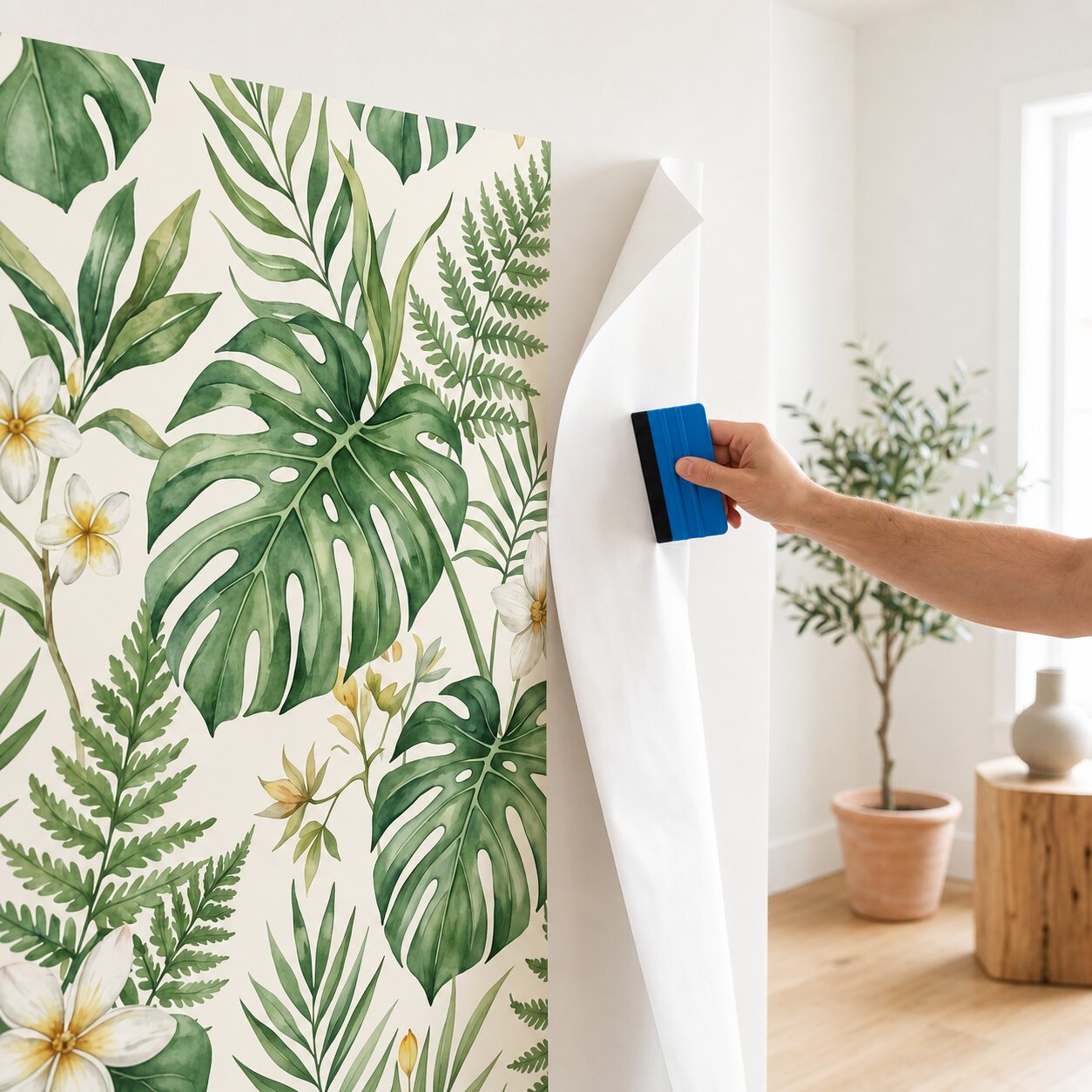
Peel and stick wall murals typically cost between $20 and $500+ depending on size, material, and whether the design is pre-made or custom-printed. Three factors drive most of the price difference: wall coverage area, substrate quality (vinyl, non-woven, or fabric), and the level of customization involved. Unlike hand-painted murals or professionally installed wallpaper, peel-and-stick options are designed for DIY application, which means the product price is generally the total cost.
Most buyers fall into one of three spending tiers. Where you land depends primarily on how much wall you need to cover and whether a standard size works for your space.
At the lower end, pre-packaged murals in fixed dimensions are sold through mass-market retailers. These products typically cover smaller accent areas — a section of wall behind a desk, a nursery corner, or a partial feature wall. The price is low because the design is pre-printed at set sizes, which means you adapt your space to the product rather than the other way around.
The tradeoff: limited design flexibility, thinner vinyl materials, and panel seams that may be more visible. For renters decorating a short-term space or anyone testing whether they like the look before committing to a larger purchase, this tier is a reasonable starting point.
This is the most active segment of the market for homeowners. Products here tend to use thicker, more dimensionally stable substrates — non-woven papers and poly-woven fabrics rather than thin PVC vinyl — and often feature better adhesive formulations that are easier to reposition during installation.
Many mid-range options are sold through curated design marketplaces and print-on-demand platforms, which offer a wider selection of artwork styles. A standard 6x8 ft panel set commonly falls into this range, making it practical for a bedroom accent wall without requiring a full custom order.
Custom-sized murals, printed to your exact wall dimensions, typically start around $200 for a smaller accent wall and scale upward from there. At this tier, you're paying for per-square-foot custom printing, architectural fit, and in some cases design services — not just material.
For large walls — a 12x9 ft living room feature wall, for example — a premium fabric or non-woven mural can comfortably reach $600–$900 before shipping. Commercial installations or ceiling applications push well past that.

Understanding the gaps between tiers comes down to four variables.
Custom mural pricing is linear — you pay per square foot, and larger walls cost more. Most vendors that print to order also require a bleed margin of 1–2 inches on each side to account for uneven walls and ceiling variations, which can add 10–15% to the total square footage ordered. Measure carefully before ordering, and factor that overage in.
The substrate — the surface material the design is printed on — is the single biggest quality differentiator. Standard PVC vinyl is the least expensive to produce and the most common in budget products. Non-woven papers and poly-woven fabrics cost more but resist stretching during installation, hide minor wall imperfections better, and typically use low-tack adhesives that are more forgiving to remove.
Some vendors also offer paper-based peel-and-stick options, which tend to sit between vinyl and fabric on both price and performance. Material upgrades at custom print houses typically carry a 40–60% cost premium over base vinyl pricing.
A pre-made design from a catalog carries no design overhead — the artwork exists, and the manufacturer simply prints it at scale. Custom work adds image upscaling (to prevent pixelation on large surfaces), panel layout planning, and sometimes design revision rounds. Some platforms charge flat fees for modification services; others bundle these costs into the per-square-foot price.
If you want to use a personal photograph, expect that image processing is either included in the custom price or listed as an add-on.
Direct-to-consumer brands that print in-house often offer better material value than boutique showrooms or marketplace aggregators. Trade program pricing — available to interior designers and contractors through programs at various brands — runs 20–30% below public retail, which is worth knowing if you're working with a designer on a larger project.
The clearest way to compare mural options across different vendors is to normalize everything to a per-square-foot cost. Current market pricing breaks down roughly as follows:
| Tier | Format | Approx. Cost Per Sq. Ft. |
|---|---|---|
| Budget (fixed size) | Pre-packaged vinyl panels | $1.40–$2.00 |
| Mid-range (print-on-demand) | Non-woven or poly-woven | $3.50–$6.50 |
| Premium custom | Heavy fabric, canvas, or textured non-woven | $7.00–$11.00+ |
To calculate your project cost: measure your wall dimensions, add 1–2 inches on each side for bleed, convert to square feet, and multiply by the per-square-foot rate for the material tier you're considering.
Example: a 12 ft x 9 ft wall has 108 sq ft of visible area. With bleed, you're ordering approximately 115 sq ft. At $5.50/sq ft for a mid-grade non-woven mural, that's roughly $630 before shipping.

This comparison depends on which cost you're looking at — material only, or fully installed.
On a per-square-foot basis, peel-and-stick material often costs more than unpasted traditional wallpaper. The pressure-sensitive adhesive built into the backing adds manufacturing cost. However, traditional wallpaper requires professional installation in most cases, which adds $3–$8 per square foot in labor, translating to $325–$825 for a single standard room according to Angi's 2025 installation data.
The result: a peel-and-stick mural covering the same wall will typically cost less on day one than wallpaper plus installation, assuming DIY application. Over a 10–15 year horizon, traditional wallpaper — which lasts considerably longer than the 1–5 year functional lifespan of most peel-and-stick products — tends to amortize at a lower annual cost. For renters or anyone expecting to redecorate within a few years, peel-and-stick wins the value calculation. For stable homeowners with long time horizons, traditional wallpaper is worth the comparison.
This is where the price difference is most dramatic. Professional mural painters charge $10–$50 per square foot for residential interior work, with average projects running $1,570–$3,280 according to Angi's 2026 data. A standard 80 sq ft accent wall could cost $800–$4,000+ for a painted mural, depending on the artist and design complexity.
A custom peel-and-stick mural covering the same wall typically runs $400–$750 in material cost at mid-to-premium pricing, installed in a few hours rather than days.
The hand-painted mural does offer things a printed product cannot: unique artistry, texture, permanence, and a one-of-a-kind piece tied to a specific place. For buyers who want those qualities, the cost premium may be justified. For buyers who want large-scale imagery at a manageable price, peel-and-stick is a different product category, not an inferior one.

The direct labor cost for professional installation is typically zero if you're doing it yourself — which is the intended use case for most peel-and-stick products. Unlike traditional mural wallpaper that requires paste, booking time, and often a professional hanger, self-adhesive murals are designed for proper installation in simple steps: measure, cut panels to fit, peel, smooth, and trim. You'll need basic tools: a smoothing squeegee or plastic card, a utility knife for trim cuts, and a level or tape measure. Basic kits run $15–$40 at hardware stores.
Where costs can creep in is wall preparation. Peel-and-stick murals require a smooth, clean surface — freshly painted walls need to cure for at least four weeks before application, and textured walls (orange peel, knockdown, skip trowel) typically need to be skim-coated flat first. If you hire that prep work out, expect $100–$500 depending on the wall condition and room size. That's not an installation cost in the traditional sense, but it's real money that belongs in your project budget.
Peel-and-stick murals have a functional lifespan of roughly 1–5 years, with the range driven by environmental conditions more than product quality. In a stable, climate-controlled room — a bedroom, a dining area — a well-made fabric or non-woven mural can reach the upper end of that range without issues. These more durable substrates resist humidity better and maintain print quality over time. The format's real strength isn't just longevity — it's the flexibility to refresh your space when your tastes change, which opens up endless possibilities for seasonal updates, rental refreshes, or simply following where your inspiration leads. In high-humidity spaces (bathrooms, poorly ventilated kitchens), adhesive degradation tends to accelerate.
The bigger financial risk is wall damage on removal. Products marketed as "damage-free" are generally designed for smooth, properly cured walls painted with satin or semi-gloss finishes. On flat paint, older builder-grade finishes, or walls that weren't primed before painting, aggressive adhesives can pull paint when removed. If that happens, drywall repair averages $609 nationally in 2026 per Angi's data — which can quickly exceed the cost of the mural itself.
For renters protecting a deposit, investing in a mid-range or premium product with a documented low-tack adhesive is often worth the higher upfront cost. A cheap mural that damages the wall on the way out can be far more expensive than the purchase price suggests.
A few practical approaches:
Order a sample first. Most custom mural vendors sell small samples for $3–$20. Testing adhesion and color on your specific wall before committing to a full order is worth the nominal cost.
Time seasonal sales. The home decor market tends to run aggressive promotions from late spring through August, and again during the November–December holiday window. Discounts of 20–45% are common during these periods.
Use affiliate or loyalty codes. Many mural brands run referral and newsletter signup programs that offer 10–15% discounts on a first order.
Look at direct-to-consumer vendors. Brands that print and ship in-house often offer better material value than those selling through intermediary marketplaces, where platform fees are baked into the price.
If you're working with a designer, ask about trade pricing. Trade program discounts of 20–30% are available at numerous wallcovering brands and can meaningfully reduce the cost of a premium installation.
Pricing varies more by wall size than most people expect.
The per-square-foot metric is generally the most reliable way to compare murals across different formats, panel sizes, and pricing structures. Many vendors price by panel set, roll, or fixed product — which obscures the actual unit cost. Normalizing to square-foot pricing reveals the real tiers in the 2026 market.
The following breakdown reflects observed current pricing across market tiers, drawing on vendor pricing pages, Angi's 2026 wallpaper cost data, and the deep-research pricing report compiled for this guide:
| Vendor / Format | Material Type | Cost Per Sq. Ft. |
|---|---|---|
| Fixed-size mass-market (e.g., Walmart, Target) | Thin PVC vinyl, pre-printed | $1.40–$2.00 |
| Mid-market custom print services | Poly-woven fabric, matte non-woven | $5.00–$6.90 |
| Premium custom (e.g., Wallsauce, Limitless Walls) | Heavy non-woven, canvas, natural fiber | $7.43–$11.25 |
| Spoonflower peel-and-stick woven linen | Woven linen fabric | $5.11–$11.25 |
| Zeekohome custom peel-and-stick | Printed fabric, custom scaled | ~$2.32–$4.18/sq ft |
Sources: Public pricing pages and product listings from several leading peel-and-stick wallpaper and custom mural vendors, along with independent comparison guides.
One structural note: vendors that price in rolls or panels often appear cheaper at a glance. A 2-ft x 12-ft panel (24 sq ft) sold for $125 flat works out to $5.21/sq ft — which lands in mid-range territory despite appearing to be a single low-cost item. It's worth calculating the effective square-foot rate before comparing prices across brands.
Ordering custom murals to exact wall dimensions doesn't account for the physical realities of installation. Industry practice calls for a 1–2 inch bleed on all sides to accommodate ceiling irregularities, unplumbed corners (common in residential construction), and the alignment margin needed when panels must be matched. On a 12x9 ft wall, a 2-inch bleed per side pushes the material order from 108 sq ft to approximately 115 sq ft — roughly a 6–7% cost increase before you've selected a material or brand.
Moving from base vinyl to mid-grade non-woven typically adds around 40% to the per-square-foot rate; moving from non-woven to heavy poly-woven or fabric can add another 40–60%, according to pricing analysis across custom print vendors in the 2026 market. For a 100 sq ft wall:
The functional differences that justify those premiums: dimensional stability (fabric doesn't stretch during installation), adhesive chemistry (low-tack adhesives designed for clean removal), and print quality (deeper ink saturation and fidelity at large sizes).
Custom mural pricing includes services and production steps that pre-made products don't require. Understanding what's actually bundled into the price helps clarify whether the premium is worth it for a given project.
A standard custom order at a mid-to-premium vendor typically includes:
Some vendors include one or two digital proofing rounds; others charge for revisions beyond the first. Flat modification fees — for cropping, color adjustment, or repositioning elements within a design — typically range from $35–$135 depending on the vendor and complexity.
A notable 2026 development: buyers can commission AI-generated high-resolution artwork for roughly $30–$100 through platforms that specialize in large-format output files, then submit those files to print-on-demand mural services. This workflow bypasses traditional artist commission fees (which can run $500–$1,800+ for original custom artwork) while still producing a genuinely unique design. The material and printing cost is the same as any other custom file submission.
For reference, here is a standardized price comparison for a 100 sq ft accent wall (approximately 10x10 ft) across a range of commonly cited mural vendors, based on current pricing at time of research:
| Brand | Material | Est. Cost for 100 Sq. Ft. | Notes |
|---|---|---|---|
| Mass-market (Walmart/Target) | Thin vinyl, fixed size | $140–$200 | Pre-sized; may not fit exact wall |
| Peel And Stick Wall Murals | Canvas-textured matte white vinyl with removable, pressure-sensitive adhesive | ~$500–$600 | Priced per square foot; repositionable during installation, strong long-term bond, eco-friendly inks for high-definition, long-lasting color |
| Wallsauce peel-and-stick | PVC-free self-adhesive | $743–$929 | Premium UV-resistant, ultra-matte |
| Limitless Walls | Peel-and-stick fabric/canvas | $750–$975 | Multiple substrate options |
Sources: Peel and Stick Wall Murals, Wallsauce US pricing, and Limitless Walls pricing blog
Note: prices reflect base material at time of research (April 2026) and do not include shipping (except for PASWM which offers free shipping), taxes, or applicable trade discounts. Retail pricing changes frequently; verify directly with each vendor before ordering.
Most of these vendors sell samples — typically 8x10 in to A3-size swatches — for $3–$20. Given that color rendering and adhesive performance vary across wall finishes, purchasing a sample before committing to a full order is a practical step that can prevent costly remakes.
"Affordable" in the mural market can mean several different things. Here's a realistic breakdown of what you get at each price point, and where the practical limitations are.
Products in this range are pre-printed in manufacturer-set dimensions. The primary limitation isn't just aesthetics — it's fit. If your wall is 11 ft wide and the product is 8.5 ft, you either have uncovered wall or you order multiple units and manage the seam yourself. The vinyl is typically thinner, the adhesive less forgiving, and the design catalog narrower.
Where these products make sense: small spaces, temporary applications, or buyers who want to try peel-and-stick before investing in a custom order.
This range opens access to better materials and, in many cases, modest customization. Print-on-demand platforms in this range often allow size adjustments within limits, offer a broader design library, and use substrates with documented removability testing. For a standard bedroom accent wall in a smaller room (under 70 sq ft), a mid-range order can cover the full wall without requiring a premium custom print.
At this level, you're ordering a mural designed around your specific wall. The material quality is generally higher, the design is scaled to fit, and the installation result is more likely to look intentional rather than compromised. For living rooms, dining rooms, and commercial spaces where first impressions matter, this is where most serious buyers land.
Once you're covering walls larger than 100 sq ft, or selecting premium substrate materials (heavy canvas, natural fiber, textured non-woven), costs exceed $500 even at mid-range per-foot pricing. Commercial and hospitality applications frequently operate in the $1,000–$2,500+ range for a single feature wall. At this scale, trade program discounts and direct vendor relationships become financially meaningful.
Room size and function affect both the budget required and the product specifications that make sense.
Bedrooms are the most common application for peel-and-stick murals because the low-humidity, climate-controlled environment is ideal for adhesive longevity. A standard master bedroom accent wall (12 ft x 8–9 ft) yields 96–108 sq ft of coverage. With a 15% bleed margin included, the material order runs approximately 110–125 sq ft.
At mid-range pricing (~$5.50/sq ft), the material cost for a full master bedroom accent wall runs approximately $600–$690. A smaller bedroom or nursery (10 ft x 8 ft) runs closer to $440 at the same rate — and in nursery applications, removability is often a primary decision factor since children's design preferences evolve quickly.
Living rooms typically require more coverage than bedrooms, and the higher visibility means material quality matters more. A 16 ft x 10 ft living room feature wall covers 160 sq ft — pushing toward 185 sq ft with bleed. At mid-range pricing, that's approximately $1,000–$1,050; at premium fabric pricing (~$8.00/sq ft), approximately $1,475.
An emerging 2026 trend noted by House Beautiful: applying murals to ceilings rather than walls. This is worth a specific caution — ceiling application with heavy peel-and-stick panels essentially negates the DIY advantage because overhead work typically requires professional labor, which reintroduces $3–$8/sq ft in labor costs, plus potential scaffolding rental for high ceilings.
Bathrooms and kitchens introduce humidity and temperature variation that accelerates adhesive degradation. Most peel-and-stick mural vendors either explicitly exclude these environments or recommend specific moisture-resistant substrates for backsplash or vanity wall applications. If you're planning a bathroom mural, verify the vendor's environmental rating for the specific product before ordering.
All the pricing data in the world doesn't help if you're still not sure where to start. Here's a practical buyer guide organized by the most common use cases — so you can decide where to shop and what to look for before you order.
Renters need two things above everything else: clean removal and a product that won't forfeit a security deposit. For this use case, mid-range non-woven or poly-woven fabric murals in the $5–$7/sq ft range are generally the safest choice. The low-tack adhesives used in this tier are specifically formulated for painted drywall. Avoid budget vinyl — its adhesives are less predictable on flat paint, which is the most common finish in rental units. Order a sample, test it on a less visible wall section, and verify it peels cleanly before committing to a full install.
Bedrooms are forgiving environments — low humidity, consistent temperature, no cooking steam or shower splatter. This means almost any quality product will perform well here. The bigger decision is design: a dramatic focal point behind the bed tends to work best when the mural spans roughly two-thirds of the bed frame's width for visual balance. Nature scenes, abstract art, botanical prints, and geometric patterns are all popular in 2026, and most mid-range custom mural collections offer a diverse selection across all of these styles. Budget: $250–$700 for a standard master bedroom accent wall.
For nurseries, removability is the priority — children's tastes change fast, and you may want to update the room within a few years. Fixed-size products in the $50–$150 range work well for smaller nursery walls (typically 8x8 ft or smaller), and many feature illustrated animals, soft botanicals, and gentle abstract patterns designed for children's spaces. If you need a specific custom size, several print-on-demand services offer smaller custom orders in this price range. Look for products that explicitly list "low-tack" adhesive and confirm compatibility with the wall's paint type before hanging.
Living rooms carry more scrutiny than any other room — guests see them, lighting is more varied, and the wall often needs to anchor a large space as a statement piece. Thin vinyl or visible seams will stand out more here than in a bedroom. For a proper statement wall, budget for a premium non-woven or canvas mural in the $7–$9/sq ft range, which delivers the glare-free matte finish and seamless panel alignment that high-visibility spaces require. Expect to spend $700–$1,500 for a full living room accent wall depending on size.
Standard peel-and-stick murals are not designed for high-humidity environments. If you want to transform a bathroom feature wall — behind a vanity, for example — look specifically for vendors that rate their products for moisture-prone spaces or offer vinyl substrates with moisture-resistant adhesive. Not all do. Many vendors explicitly exclude bathrooms and kitchens from their damage-free removal guarantees. Read the product spec carefully before ordering for these rooms.
For buyers who need custom sizing but want to keep costs down, the lowest transparent pricing in the current market tends to come from direct-to-consumer brands that publish their per-foot rates clearly (rather than requiring a quote). At the time of research, mid-tier custom vendors were offering peel-and-stick non-woven options from approximately $5.00–$6.90/sq ft. Combine that with seasonal sales (late spring through August tends to produce the deepest discounts), newsletter or affiliate codes for 10–15% off first orders, and free sample testing before committing, and you can meaningfully reduce the total cost versus paying full retail at a premium brand.
Beyond the numbers, a mural is a design decision. These ideas are meant to help you explore what's possible and decide what might work in your space.
Certain design approaches can visually expand a tight space. Murals featuring depth — forest paths, long hallways, open landscape vistas, or any scene that draws the eye toward a distant horizon — tend to make walls recede rather than close in. Light-colored backgrounds (soft blues, pale greens, warm whites) enhance the effect. Avoid busy repeating patterns in small rooms; a single large-scale composition with clear focal depth works better than tile-like repetition.
Abstract art murals are another strong option for compact spaces — they add visual interest without the literal depth cues of a landscape, and a well-chosen abstract piece can create a sense of movement that distracts from a room's actual dimensions.
The most popular styles in the 2026 residential mural market include:
Nurseries are one of the most popular rooms for peel-and-stick murals precisely because removability makes them practical — the room's purpose changes, and so does the decor. Popular nursery styles include illustrated woodland animals, soft watercolor botanicals, cloud and sky scenes, and gentle geometric shapes. Many parents use the mural as the starting point for the room's entire color palette, pulling accent colors from the mural design into bedding, rugs, and furniture. If you're working with a smaller wall, a single oversized element — a large tree, a moon, a single animal figure — often reads better at scale than a busy, repeating scene.
Murals don't have to cover a full flat wall. Some of the most effective uses in 2026 interior design work with — or around — existing architectural features:
Short answer: Most buyers spend $80–$400 for a standard accent wall, depending on size and material tier.
Most peel and stick wall murals for a standard accent wall cost between $80 and $400. Budget products in fixed sizes start around $20–$80 and work well for smaller walls or temporary applications, while custom-sized murals for a full bedroom or living room wall typically run $250–$700 depending on size and material. At the premium end — large walls, heavy fabric substrates, or commercial installations — costs can exceed $1,000. The main variable is how much wall you need to cover: custom vendors price per square foot, so the math scales directly with your wall dimensions.
Short answer: A printed mural is typically far cheaper — $400–$900 in material vs. $1,570–$3,280 for a professional muralist.
A peel-and-stick mural is almost always less expensive than a professionally painted one if you're installing it yourself. According to Angi's 2026 data, professional mural painters charge $10–$50 per square foot, with average residential projects running $1,570–$3,280. A custom peel-and-stick mural covering a comparable wall typically costs $400–$900 in material — installed in hours rather than days. The exception: if you hire professional installation for the peel-and-stick mural, you close some of that gap. The painted mural's advantages are permanence, unique artistry, and physical texture that a printed product can't replicate.
Short answer: On smooth, properly cured painted walls, most quality murals remove cleanly at no cost. Risk increases significantly on flat paint or unprimed drywall.
On smooth, properly painted walls with a satin or semi-gloss finish, quality peel-and-stick murals are designed to remove cleanly without damaging the surface. Removal is DIY with no labor cost. The risk is real on flat paint, improperly primed drywall, or walls where paint was applied less than four weeks before installation — in those cases, aggressive adhesives can pull the paint face on removal. If wall damage does occur, drywall repair averages $609 nationally in 2026, according to Angi — which can exceed the mural's original cost. Ordering a sample and doing a test patch in a low-visibility area before full installation is a worthwhile precaution.
Short answer: Roughly $1.40–$2.00 for budget fixed-size vinyl, $5.00–$6.90 for mid-range custom non-woven, and $7.43–$11.00+ for premium fabric substrates.
Per-square-foot costs range from roughly $1.40 for mass-market fixed-size vinyl products to $11+ for premium custom fabric substrates. The middle of the market — custom non-woven and poly-woven murals from mid-range print-on-demand vendors — typically falls between $5.00 and $6.90 per square foot. Premium brands with PVC-free, heavy-fabric options commonly price in the $7.43–$9.29 range (Wallsauce US, April 2026). Because many vendors sell by panel or roll rather than by the foot, calculate the effective square-foot rate before comparing prices across brands.
Short answer: Usually yes, upfront — because DIY installation skips $325–$825 in professional labor costs. Long-term, traditional wallpaper's greater durability can make it more economical.
On a day-one total cost basis, peel-and-stick typically comes out lower because it eliminates professional labor. Traditional wallpaper installation adds $3–$8 per square foot in labor costs according to Angi, which translates to $325–$825 for a single standard room. If you apply the peel-and-stick mural yourself, you skip that entirely. The nuance is longevity: traditional wallpaper tends to last 10–15 years, while peel-and-stick murals typically reach 1–5 years before needing replacement. Over a decade, a traditional installation often amortizes at a lower annual cost — making the right choice dependent on how long you plan to keep the same look.
A single framed canvas or large art print in a comparable size to a feature wall mural can run $100–$500 or more depending on the print type and frame, but covers a fraction of the wall area. A peel-and-stick mural covering a full 10x10 ft wall at mid-range pricing runs $400–$600 — more than a single piece of art, but delivering floor-to-ceiling immersive coverage that framed art doesn't approximate. The comparison is really different objectives: art as a focal point versus wall transformation as the goal.
Custom pricing at mid-to-premium vendors typically includes image scaling to your exact wall dimensions, panel layout planning, substrate material in the finish you select, and digital proofing. Some vendors bundle one or two design revision rounds; others charge per revision or per modification type. Image upscaling for personal photographs — so they don't pixelate at large print sizes — is usually included in the custom price. What's typically not included: professional installation, shipping (which can be substantial for large rolls or heavy substrates), and extensive artistic modifications beyond basic resizing.
Mid-range print-on-demand platforms generally offer the best balance of quality and price for buyers who need custom sizing without the premium brand markup. For the lowest absolute price on fixed-size products, mass-market retailers carry acceptable options for smaller walls or temporary applications. If you need custom sizing with transparent pricing, several vendors in the $5–$7/sq ft range publish their per-foot rates clearly, which makes budget planning easier than brands that require a quote. Ordering samples ($3–$20 depending on vendor) before committing to a full custom order is a reliable way to evaluate adhesive quality and color accuracy without risking the full purchase.
The comparison isn't just about price — it's about what the price buys. A peel-and-stick mural's cost stays the same regardless of how complex the design is: a detailed forest scene costs the same to print as a solid gradient because the digital printing process doesn't scale with image complexity. A painted mural's cost scales directly with complexity — detailed work requires more of an artist's time, which is billed by the hour or per square foot. Simple painted murals ($10–$20/sq ft) can overlap with the upper range of premium peel-and-stick pricing. Complex painted murals ($40–$50/sq ft and up) are in a completely different financial category.
The lowest total cost comes from a pre-sized, fixed-format vinyl mural from a mass-market retailer, applied DIY, on a wall that's already smooth and properly painted. These products can cover a partial wall for $20–$80 with no additional labor or prep costs. For buyers who need custom sizing — a specific wall that doesn't match a standard product format — the lowest entry point with quality custom printing is typically in the $5–$6/sq ft range from vendors who publish transparent per-foot pricing. Using seasonal sales (late spring through August, and November–December) and available promotional codes can reduce that further by 15–30%.
Charles Platon is the owner of Peel and Stick Wall Murals, a California-based leader in large-format wall decor printing. With a career rooted in photographic printing since the 1980s, Charles blends old-school craftsmanship with modern wall design innovation. After a decade at Noritsu, he returned to his family's printing business — founded in 1952 — and grew it into a trusted partner for brands like Panda Express, Guess, and Crate and Barrel.
His deep technical expertise, creative vision, and customer-first approach drive every mural Peel and Stick Wall Murals produces. When he's not overseeing production or collaborating on custom wall installations, Charles enjoys blues music and spending time with his daughter in New York.
This guide was created using a combination of expert knowledge, industry research, and content structuring tools. While AI-assisted tools (e.g., outline suggestions, formatting support) were used to improve organization and clarity, all research, writing, and final editing were performed by a human author with subject-matter expertise in large-format printing and wall decor.
All factual claims are supported by reputable sources, and the content was manually reviewed to ensure accuracy, readability, and helpfulness for real users — not just search engines.

Comments will be approved before showing up.

 MADE IN THE USA

